What is the NPPE?
The National Professional Practice Examination (NPPE) is the law and ethics exam that engineers and geoscientists must pass to become licensed in most of Canada. It does not test technical engineering. It tests whether you understand your duties to the public, ethics, professional practice, contract and tort law, professional law, and how regulators discipline members.
Fourteen engineering and geoscience regulators use the NPPE. You register through your provincial or territorial regulator, usually after you apply for your licence (P.Eng. or P.Geo.). Passing it is one licensing requirement, alongside academic qualifications and work experience.
About 10 questions are unscored trial questions, and you cannot tell which ones. The exam is delivered by Meazure Learning with remote proctoring, and since June 2026 candidates also need a phone or tablet as a second camera. Source: nppexam.ca and regulator websites, checked October 2026.
What the exam covers
The official blueprint (2017) sets how many questions come from each area. A revised blueprint is being prepared, so check nppexam.ca before your exam.
Professional Practice and Law are more than half of the exam. PMCLEAR's question bank follows the same six areas.
NPPE exam dates
| Exam dates | National registration deadline |
|---|---|
| January 11–13, 2027 | November 27, 2026 |
| March 22–24, 2027 | February 12, 2027 |
| June 7–9, 2027 | April 23, 2027 |
| August 23–25, 2027 | July 2, 2027 |
| November 1–3, 2027 | September 24, 2027 |
The dates are the same everywhere in Canada, but your regulator may set an earlier deadline: for example, APEGS (Saskatchewan) closes registration for January 2027 on November 23, 2026. After you register, you book a time slot in a separate booking window. Late registrations are not accepted. Source: NPPE exam dates.
The NPPE in your province or territory
Click your province or territory on the map to see your regulator and its rules.
uses the NPPE its own exam
Fees, attempt limits and extra requirements are set by each regulator and change over time. Always confirm on your regulator's website. Map: SVG Maps by Victor Cazanave, CC BY 4.0.
Are you ready for the NPPE?
Tick what you can honestly say about yourself.
The six NPPE areas
Questions are organized by the NPPE blueprint. Laws differ between provinces and territories: most questions test national principles, and an Ontario supplement covers Ontario-specific rules.
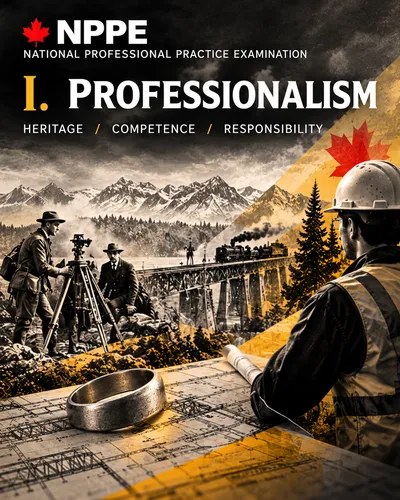
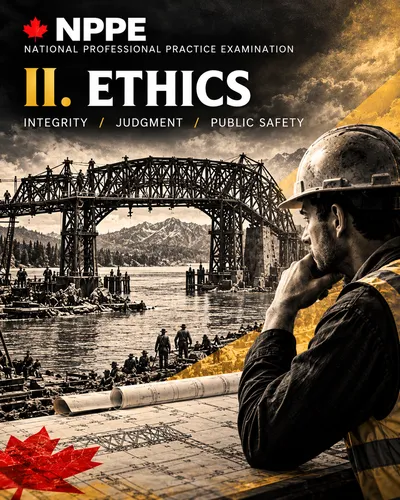
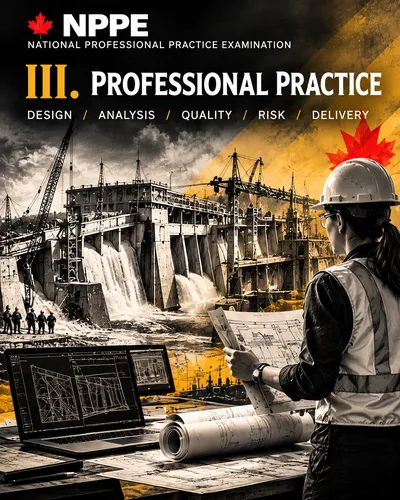
Laws and professional requirements can change. Always check your regulator's current act, regulations, and code of ethics when applying this material in practice.
Our questions are hard, on purpose
PMCLEAR NPPE questions are longer and more complicated than most practice questions. Each one is a real engineering situation with extra details, a deadline, a manager or client applying pressure, and four answers that all sound reasonable. Usually two of them are almost right, and one fact in the story decides which is best.
That is how the real NPPE tests you. It is not a memory test: it checks whether you can apply the law and your code of ethics when the situation is messy.
Students who practise on realistic, difficult scenarios find the real exam easier. When you have worked through hundreds of hard cases, the exam questions look familiar, you read them faster, and you recognise the trap answers. To help you get there:
- Every option is explained: why it is right or wrong, and why the best answer beats the close second.
- "Stuck? Show the key trigger" highlights the sentence in the scenario that decides the answer.
- 🔊 Listen and 🌐 translate: hear any question read aloud, or open it in your own language. The English stays on screen, because the exam is in English.
- AI Tutor gives hints before you answer and explains afterwards.
How it works
1. Read the scenario
Each question is a realistic situation: a client, an employer, a design decision, a complaint. Four plausible answers, one best.
2. Learn from every option
After you answer: why each option is right or wrong, the best answer against the close second, the deciding fact and the principle behind it.
3. Ask the AI Tutor
Stuck? Ask for a hint before you answer: it points you to the facts that matter without giving the answer away. After answering, ask it to explain or ask a follow-up question.
Price
- 3 days of full access to all published questions
- 5 AI Tutor requests
- No card needed; your progress is kept
- All published NPPE questions and explanations, plus new questions as they are added
- AI Tutor: up to 20 requests a day and 200 a month
- One payment, nothing renews automatically
AI Tutor has fair-use limits so it stays fast and affordable for everyone. When you reach a limit, you can keep studying with all questions and explanations; the AI allowance resets automatically. 60 study lessons are in preparation.
Why engineers take this exam: a short history
1907: the Quebec Bridge collapses. During construction over the St. Lawrence River, the bridge's southern cantilever collapsed and about 75 workers were killed. The inquiry blamed engineering errors and weak oversight: warnings about deforming steel were not acted on in time. A second accident in 1916 killed 13 more. The bridge finally opened in 1919.
From 1920: engineering becomes a regulated profession. After disasters like this, the provinces passed laws that let only qualified, licensed people practise engineering and use the title "professional engineer". Each province and territory still has its own act and its own regulator.
1925: the Iron Ring. The Ritual of the Calling of an Engineer, written by Rudyard Kipling, was first held in 1925. New engineering graduates receive an iron ring worn on the little finger of the working hand, a reminder of their obligation to the public. It is a tradition, not a licence.
Today: the NPPE. Technical skill alone is not enough. Engineers make decisions that affect public safety, contracts and people's lives, so regulators require proof that you know your legal and ethical duties. The NPPE is that proof: one national exam, used by 14 regulators, delivered online five times a year.
Questions
Is PMCLEAR connected to the NPPE, Engineers Canada or my regulator?
No. PMCLEAR is independent study material. It is not affiliated with, endorsed by or approved by Engineers Canada, Professional Engineers Ontario, any other provincial or territorial engineering regulator, or the organization that administers the NPPE. The questions are written for practice and are not real exam questions.
Do the answers apply in my province?
Most questions test principles shared across Canada. Where an answer depends on a provincial act, the question says which jurisdiction it uses. Always check your own regulator's current act, regulations and code of ethics.
Is the AI Tutor legal advice?
No. It is a study aid that explains the practice questions using PMCLEAR's reviewed explanations. It can be wrong; for a real situation, ask your regulator or a lawyer.
What happens when the trial ends?
You keep your progress and can still open the free sample questions. Full access and the AI Tutor continue when you buy the 3-month plan.