PSM I exam prep in simple English
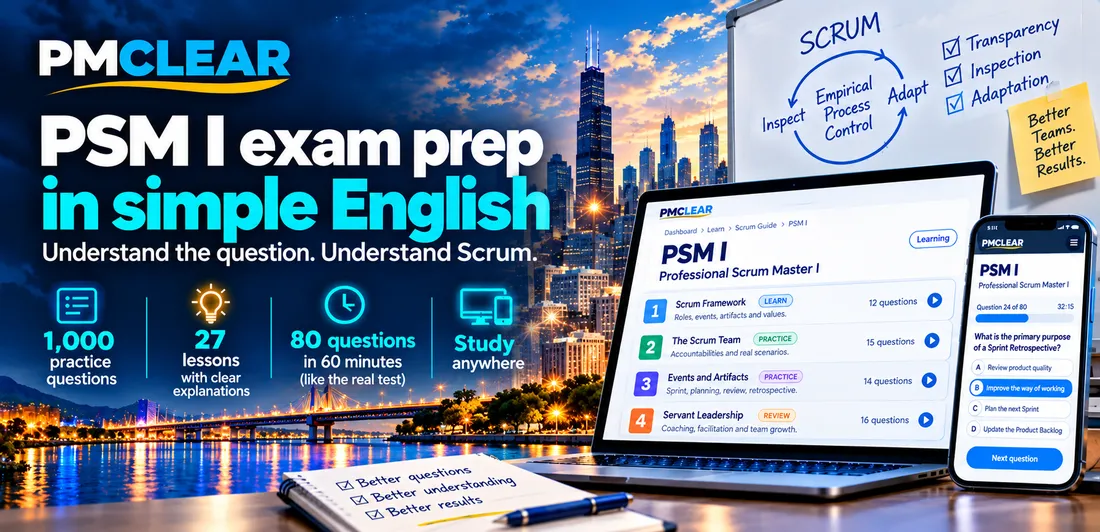
Built for candidates whose first language is not English. PSM I tests exact Scrum rules in fast, tricky English. PMCLEAR explains every question in simple words, so you understand the question and the Scrum logic behind it.
📣 Sign up free and get 3 days of complimentary full access. PSM I exam simulations and 1,000 exam-level questions, each explained in simple English and in your own language. 🤖 AI tutor: coming soon
- ✓ 1,000 practice questions
- ✓ 80-question timed exams
- ✓ Scrum course
- ✓ Phone, tablet and computer
- ✓ Built for non-native English speakers
Evaluate yourself: 10 exam-level PSM I questions
Check your understanding of Scrum and your level with ten exam-level questions from PMCLEAR: the Sprint, the accountabilities, the events, the Definition of Done and the Scrum values. Pick your answer and see how PMCLEAR explains the Scrum logic.
What you get
PSM I practice questions
Original Scrum exam questions with explanations on all 15 Scrum topics, each with a full explanation and the Scrum Guide reference.
Start practicing →Question PSM I mock exams
60 minutes, like the real PSM I. Flag questions, review at the end, and see your score by topic.
See the exam →Levels of difficulty
From core exam level to expert English: Core, Harder, Beyond software, Advanced and Expert English.
Choose a level →Scrum course lessons open
Case decisions, diagrams, myths, traps and practice questions. 27 of 27 planned lessons are open now; new lessons are added regularly.
Open the course →Practical Scrum labs
Real team situations where you are the Scrum Master: decide step by step and see the Scrum Guide logic behind each choice.
Try a lab →Topics tracked
Scrum theory, values, the Scrum Team, every event and every artifact. See your score by topic and practise your mistakes.
See my progress →The difference: you learn the English of the question
Most PSM I courses explain Scrum. PMCLEAR also explains how the questions are written, so you stop translating word by word and start seeing exactly what is being asked.
Question types
One answer, “choose 2”, “choose 3” and true/false. Each type needs a different way of reading.
Accountable or responsible?
Who is accountable for what: Product Owner, Scrum Master, Developers. The words decide the answer.
2017 words vs 2020 words
“Development Team”, “roles” and “self-organizing” are old. Know the 2020 Scrum Guide terms.
Every answer is explained the same way
- The answer — the correct option, clearly marked.
- Why it is correct — the Scrum logic in simple English.
- Why each other answer is wrong — the trap behind it.
- Scrum Guide reference — the part of the Guide being tested.
- A short tip — one line to remember for the exam.
Plus: My mistakes, progress by topic and bank, and timed 80-question exams with a review of every question.
The PSM I exam at a glance
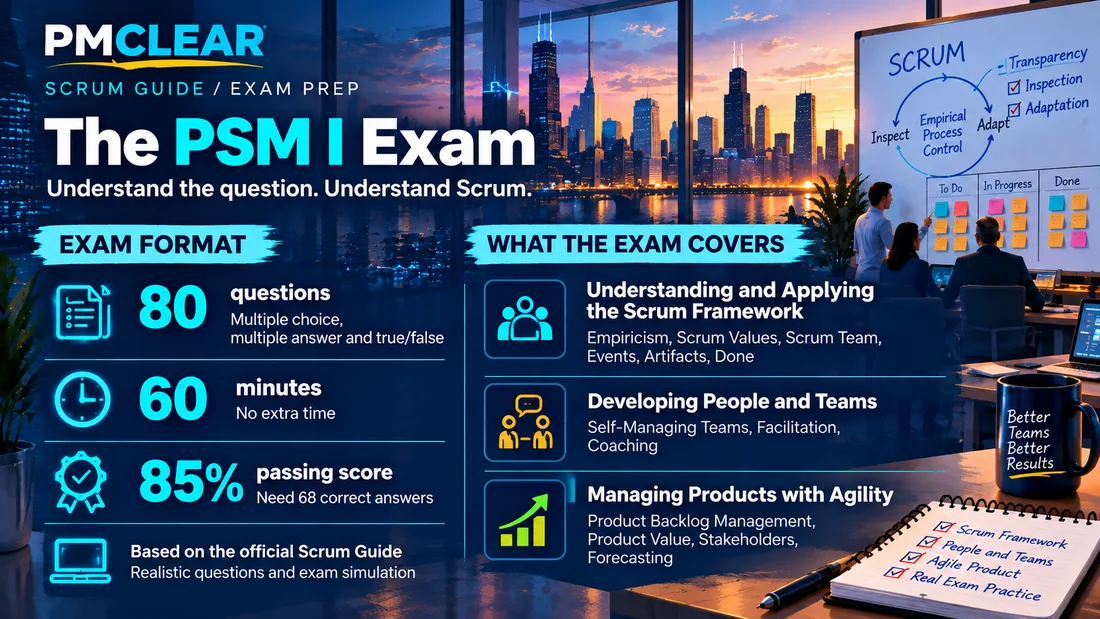
80 questions in 60 minutes, and you need 85% (68 correct answers) to pass. The questions test the 2020 Scrum Guide. Exam details can change, so check the official Scrum.org page before you book.
Free Scrum course
Lessons in simple English with case decisions, diagrams, myths, traps and practice questions, based on the 2020 Scrum Guide.
0. The PSM I exam and how to study
Format, pass mark, question types and a time strategy.
1. Complex work and why Scrum exists
Short cycles for work where much is unknown at the start.
2. The language of Scrum
Exact Scrum words: accountable vs responsible, and more.
3. The framework in one picture
3 accountabilities, 5 events, 3 artifacts, 3 commitments.
4. Empiricism, lean and the three pillars
Transparency, inspection and adaptation in practice.
5. Scrum values in real decisions
Commitment, focus, openness, respect and courage.
6. The Scrum Team
One team, one Product Goal, no sub-teams.
7. Developers
The Sprint plan, quality, daily adaptation and accountability.
8. Product Owner
Maximizing value and managing the Product Backlog.
9. Scrum Master
Establishing Scrum and the team's effectiveness.
10. Self-management and leadership
Who decides what, when and how inside Scrum.
11. The Sprint
Fixed length, one month or less, contains all other events.
12. Sprint Planning
Why, what and how: the Sprint Goal and the Sprint Backlog.
13. Daily Scrum
15 minutes for the Developers to inspect progress and adapt.
14. Sprint Review
A working session with stakeholders, not a release gate.
15. Sprint Retrospective
How the team improves quality and effectiveness.
16. Product Backlog, refinement and Product Goal
One ordered list, one Product Goal, ongoing refinement.
17. Sprint Backlog and Sprint Goal
The Developers' plan: why, what and how.
18. Increment, release and Definition of Done
When work is Done, and when you can release it.
19. Product value, stakeholders and forecasting
Value over output, and honest forecasts.
20. Quality and technical debt
Quality built in every Sprint through the Definition of Done.
21. Many teams, one product
One Product Goal, one Product Backlog, one Product Owner.
22. Scrum in the organization
Managers, PMOs and approvals around a Scrum Team.
23. Scrum beyond software
The same rules in hardware, healthcare and marketing.
24. One full Sprint, start to finish
A whole Sprint, decision by decision.
25. Reading PSM I questions; 2017 vs 2020
Exam technique and the old-vs-new traps.
26. Final review: the hardest distinctions
The pairs that cause most wrong answers.
Practical Scrum labs
Be the Scrum Master in a real team situation. Make each decision as it happens and see the Scrum Guide logic behind it. Free, about 15 minutes each.